What Does a Music Publisher Do? (And Do Independent Songwriters Need One?)
A plain-English guide to what a music publisher really does: registering songs, collecting royalties worldwide, licensing and protecting your copyright, and how to decide if you need one.
On this page
- The key points
- Publishing in one minute: songs versus recordings
- What does a music publisher actually do?
- 1. Registers your songs everywhere they need to be
- 2. Collects royalties worldwide
- 3. Licenses your music
- 4. Protects your copyright
- 5. Develops writers (in some deals)
- The different kinds of publisher
- Do independent songwriters need a music publisher?
- What to ask before you sign anything
- Music publisher key takeaways
- How Dark Lab Records Publishing can help
- Summary
If you write songs, someone will eventually tell you that you need a music publisher. Then someone else will tell you that you do not. Both can be right, because "publisher" covers everything from a global company that signs hit writers to a service that quietly registers your songs and collects your money. This guide explains, in plain English, what a music publisher actually does, what it costs you, and how to decide whether you need one.
The key points
- A music publisher looks after the song (the melody and lyrics). A record label looks after the recording. They are different rights and different income.
- Publishers register your songs, collect royalties around the world, license your music and, in some deals, pay advances and open doors.
- You do not need a music publisher to release music. You do need someone (or you yourself) to register your songs and collect publishing income, otherwise money goes unpaid.
- The deal you sign matters far more than the word "publisher" on the contract.
Publishing in one minute: songs versus recordings
Every released track contains two separate pieces of copyright. The first is the composition: the melody, chords and lyrics, owned by the songwriters. The second is the master recording: the actual audio, usually owned by the artist or the label that paid for it.
Each one earns its own money. When a track streams, the platform pays one royalty for the recording (to the artist or label) and another for the composition (to the songwriters and their publisher). Music publishing is the business of managing and earning from that second pot. If you want the full picture of where the money comes from, read our guide to performance, mechanical and sync royalties.
What does a music publisher actually do?
1. Registers your songs everywhere they need to be
Royalties are paid against data. For a song to earn, it must be registered with the right collecting organisations (such as PRS for Music and MCPS in the UK, ASCAP, BMI and The MLC in the US, and their equivalents elsewhere) with the correct writers, splits and identifiers. A music publisher does this for you and keeps the records correct. Mistakes here are the number one reason royalties go missing, which we cover in our article on black box royalties.
2. Collects royalties worldwide
Your songs are played in dozens of countries, and each country has its own society. A music publisher with international reach collects from all of them, matches the money to your songs and pays you through a single statement. That is a lot of paperwork to do alone, especially once your catalogue grows.
3. Licenses your music
When a TV show, advert, game or film wants to use your song, a licence is needed. Publishers negotiate these sync licences, set the fee and make sure you are paid. Some publishers also pitch songs actively to music supervisors, artists and labels.
4. Protects your copyright
Publishers monitor for unlicensed use, issue takedowns and chase unpaid usage. They also keep your agreements, splits and paperwork in order, which matters the moment a song becomes successful and everyone remembers what they were promised.
5. Develops writers (in some deals)
Traditional publishers may pay an advance, set up co-writing sessions and introduce you to artists and producers. In return they usually take a larger share of the income and, often, a share of the copyright. Not every publisher offers this, and not every writer needs it.
The different kinds of publisher
| Type | What you get | What it usually costs you |
|---|---|---|
| Administration company | Registration, worldwide collection, statements | A percentage of what is collected, commonly 10–25%. You keep your copyright. |
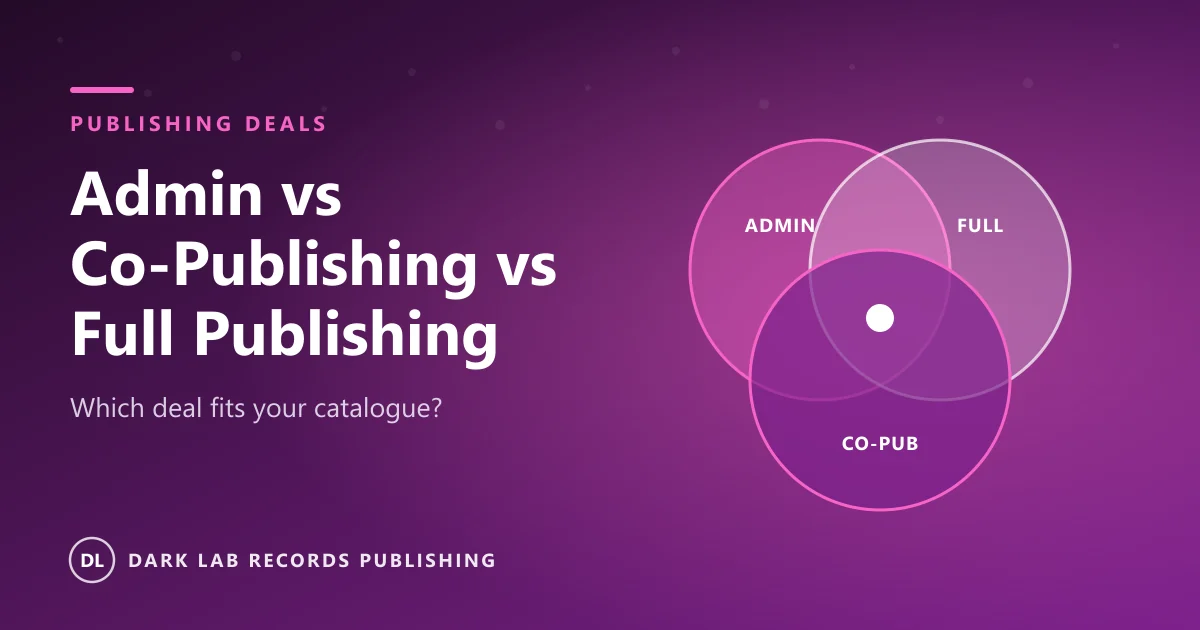
| Co-publisher | Admin plus some creative and licensing support | A share of the copyright and income, often 25%. |
| Traditional (full) publisher | Advance, pitching, creative support | Ownership of the copyright for the term and a larger income share. |
The percentages above are typical ranges, not rules: every contract is negotiable. We compare all three side by side in admin vs co-publishing vs full publishing deals.
Do independent songwriters need a music publisher?
You do not need a music publisher to put music on Spotify or Apple Music. Your distributor handles the recording side. But distribution does not register your songs for publishing income. If nobody does that, the composition side of your earnings can sit unclaimed.
So the useful question is not "do I need a music publisher?" but "who is registering my songs and collecting my publishing money?" You have three realistic answers:
- You do it yourself. Free apart from your time and some society fees. It works for a handful of songs and one territory, but gets heavy fast.
- An administrator does it for you. You keep ownership and pay a percentage. This suits most independent writers, artists, producers and small labels.
- A traditional music publisher signs you. Best when you want an advance and active career support and are comfortable sharing ownership.
A simple test: if the royalties you are probably missing are worth more than the administrator's fee, the service pays for itself. If you only have a few songs that earn very little, doing it yourself, carefully, may be enough for now.
What to ask before you sign anything
- Do I keep my copyright? With an administration deal you normally do. With others you may not.
- What is the percentage, and on what? Ask whether it applies to all income types and whether there are setup or withdrawal fees.
- How long is the term, and what happens at the end? Look for the "retention period" after termination, during which the music publisher may still collect on deals it signed.
- Which territories and which songs are covered? Whole catalogue forever is a very different deal to a few songs for three years.
- How and when do I get paid, and can I see the detail? You should receive clear statements showing each source of income.
Music publisher key takeaways
- A music publisher manages the rights to your songs, not your recordings.
- Every music publisher earns its fee by registering works, collecting royalties and licensing music, so ask which of those jobs you are paying for.
- Whether you need a music publisher depends on how many songs you have, how many countries you earn in and how much help you want.
- A music publisher who only administers your catalogue normally lets you keep your copyright. A music publisher who signs you outright usually does not.
- Before you hire a music publisher, compare the fee, the term, the territories and the statements you will receive.
- If you cannot find a music publisher you trust yet, make sure your songs are at least registered by you or by an administrator.
How Dark Lab Records Publishing can help
We act as a publishing administrator: we register your compositions, collect your royalties worldwide and give you clear statements in a dashboard, while you keep control of your catalogue. You can see exactly how it works, read about our services, or talk to the team about your songs.
Summary
A music publisher manages the business of your songs: registration, collection, licensing and protection. You can do it yourself, hand it to an administrator, or sign with a traditional music publisher, and each choice trades money, control and support differently. Whatever you choose, make sure your songs are registered and someone is collecting on every stream. That is where most songwriters quietly lose income.
Frequently asked questions
What is the difference between a music publisher and a record label?
A record label works with the master recording (the audio). A music publisher works with the composition (the melody and lyrics). Each earns separate income and holds separate rights.
Do I need a publisher to put my music on Spotify?
No. A distributor handles the recording side. But distribution does not register your songs for publishing income, so someone still needs to register them and collect composition royalties.
How much does a music publisher take?
It depends on the deal. Administration companies commonly charge around 10–25% of what they collect and you keep your copyright. Co-publishing and full publishing deals take a share of ownership and income in exchange for advances and support.
Can I be my own music publisher?
Yes. You can register as a writer and as a publisher with a society and collect both shares yourself. It is free apart from your time, but it becomes hard to manage across many songs and countries.
Written by
Dark Lab Records Publishing
Practical guidance on music publishing, royalties and rights from the Dark Lab Records Publishing team.