Performance, Mechanical and Sync Royalties Explained: How One Song Earns Money
A clear breakdown of the three main publishing royalties, who collects each one, how they are split between writer and publisher, and a checklist so none of them goes unclaimed.
On this page
- The key points
- First, which royalties are we talking about?
- Performance royalties
- Mechanical royalties
- Sync royalties
- Side by side
- Writer's share and publisher's share
- A quick checklist so nothing is missed
- Royalties: quick answers
- Common questions
- Do I get all three types automatically?
- Why is my streaming income so low?
- Let us handle the collecting
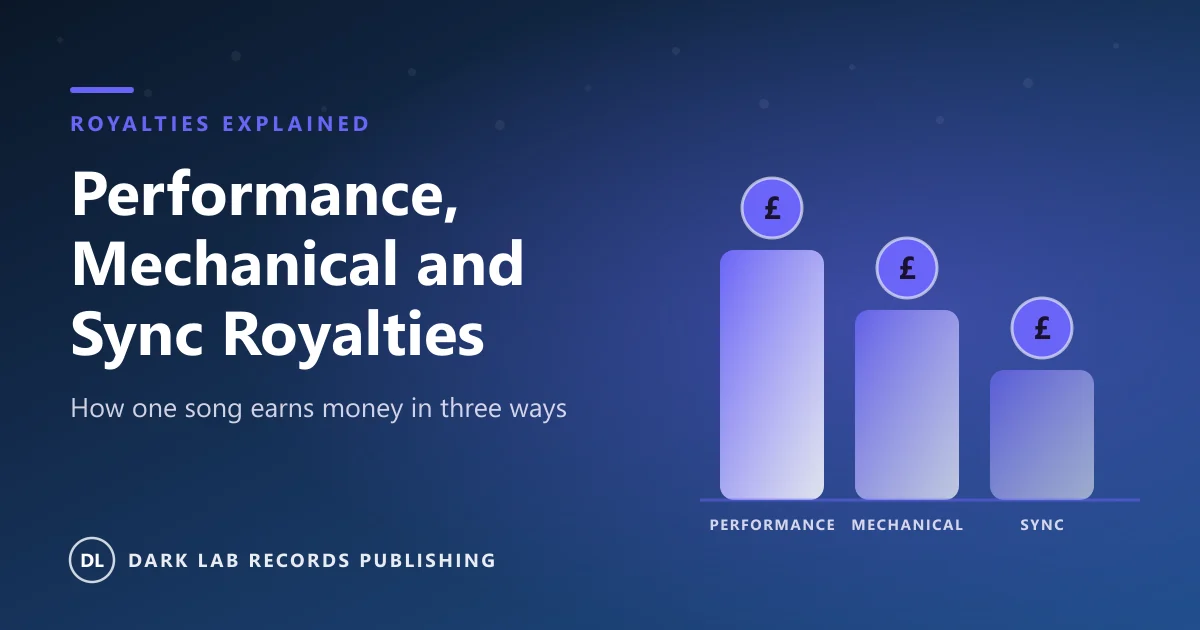
One song can earn money in at least three different ways, collected by three different kinds of organisation, at three different speeds. Most new songwriters only ever hear about "streaming royalties" and never realise that most of the income categories are collected somewhere else. This guide explains performance, mechanical and sync royalties clearly, shows who collects each one, and gives you a checklist so none of them goes unclaimed.
The key points
- Performance royalties are paid when a song is played or performed in public (radio, TV, venues, and streams).
- Mechanical royalties are paid when a song is reproduced (downloads, physical copies, and streaming's reproduction element).
- Sync royalties are fees paid when a song is placed with visuals (adverts, film, TV, games, online video).
- All three belong to the songwriters and publishers. They are separate from the money paid for the master recording.
- Each type is collected by a different organisation. If a song is not registered with the right one, that income is not paid.
First, which royalties are we talking about?
Every song has two copyrights: the composition (melody and lyrics) and the master recording (the audio). This article is about the composition side, usually called publishing income. Recording income, such as the artist's and label's share of a stream, works separately. If this is new to you, start with what a music publisher does.
Performance royalties
A performance happens whenever a song is played to the public: a radio broadcast, a TV programme, a shop or café playing music, a live gig, or a stream on a digital service. Each performance earns a small royalty for the songwriters and publishers.
These royalties are collected by performing rights organisations (PROs): PRS for Music in the UK, ASCAP, BMI, SESAC and GMR in the United States, SOCAN in Canada, and many others. You join as a writer (and as a publisher if you own your publishing), register your songs, and the society pays you for the performances it can measure or estimate.
For streaming, the performance element is generally paid through the PRO relevant to where the stream happened, which is one reason registering in more than one territory matters.
Mechanical royalties
A mechanical royalty is the right to reproduce a composition. It began with pressing records and CDs, and it still applies to downloads and physical sales. It also applies to interactive streaming, because each on-demand stream involves a copy of the song.
Collection is handled by different bodies depending on the country:
- UK and much of Europe: MCPS (in the UK, working with PRS) and equivalent mechanical societies.
- United States: The Mechanical Licensing Collective (The MLC) for digital streaming and downloads in the US, and other agencies for some physical and older licensing.
The important point: a PRO usually does not collect your streaming mechanicals. If you only joined a PRO, you may be leaving a whole income category unclaimed. This is exactly how "black box" money builds up, which we explain in our guide to black box royalties.
Sync royalties
Synchronisation, or "sync", is the licence to pair your music with moving images: a TV show, film, advert, trailer, video game or online video. Unlike performance and mechanical income, sync is negotiated one deal at a time, usually for an upfront fee.
A placement normally needs two licences: one from the owner of the composition (the songwriter or publisher) and one from the owner of the master recording (the artist or label). Fees range from modest to very large, depending on the song, the media, the territory and how long the licence lasts.
Sync can then trigger performance royalties later: when the show or advert is broadcast, the PRO may pay for those performances too.
Side by side
| Performance | Mechanical | Sync | |
|---|---|---|---|
| Triggered by | Public playing or streaming | Copying and on-demand streaming | Pairing music with visuals |
| Paid as | Regular royalties | Regular royalties | Mostly a one-off licence fee |
| Typically collected by | A PRO (PRS, ASCAP, BMI...) | A mechanical body (MCPS, The MLC...) | Negotiated by you or your publisher |
| You must register with | Your PRO | The mechanical society or your administrator | Nobody until a deal exists, but your metadata must be clean |
Writer's share and publisher's share
Publishing income is traditionally split into two halves: the writer's share and the publisher's share. In the performance system, the writer's share goes straight to the writer through their PRO, and the publisher's share goes to whoever is registered as publisher. If you are your own publisher but never registered as one, the publisher's half can go uncollected. That is a surprisingly common mistake, and a good reason to ask for help setting it up. Our royalties page shows how we handle both shares.
A quick checklist so nothing is missed
- Join a PRO as a writer, and register as a publisher if you own your publishing.
- Make sure the mechanical side is covered: MCPS in the UK, The MLC for US digital, or an administrator who handles both.
- Register every song with correct writers, shares and identifiers (see how to register a song).
- Keep metadata identical across your distributor, your PRO and your administrator.
- Check your statements regularly and look for songs that earn on streaming but show no publishing income.
- Respond to sync enquiries only once your ownership and splits are clear in writing.
Royalties: quick answers
Which royalties does a streaming play create? A stream creates performance royalties and mechanical royalties for the composition, plus separate recording royalties for the artist or label.
Who pays the royalties? Digital services, broadcasters, venues and licensees pay them to collecting organisations, which pay the writers and publishers.
How often are royalties paid? Most societies pay royalties quarterly or twice a year, and international royalties can arrive months later.
Why are my royalties lower than I expected? The usual reasons are an unregistered work, a missing publisher's share, or royalties that were not matched. Check each registration before assuming the rates are low.
Can I collect old royalties? Often yes. If a song was unregistered, many societies allow claims for earlier periods, but there are time limits, so register your works now.
Common questions
Do I get all three types automatically?
No. Each type is paid only if the song is registered with the right organisation, and the registrations are separate.
Why is my streaming income so low?
Streaming splits each stream into many small parts: recording and composition, then performance and mechanical, then your share after any splits and fees. Small per-stream amounts add up only with scale, accurate registration, and collection in every territory where you are played.
Let us handle the collecting
Dark Lab Records Publishing registers your compositions, collects performance and mechanical income worldwide and reports it in one place. Read how it works, explore our songwriter services or get in touch to talk about your catalogue.
Frequently asked questions
What is the difference between performance and mechanical royalties?
Performance royalties are paid when a song is played or streamed in public. Mechanical royalties are paid when a song is reproduced, including downloads, physical copies and on-demand streams. Different organisations collect each one.
Does my PRO collect streaming mechanical royalties?
Usually not. A PRO mainly collects performance income. Mechanical royalties are collected by bodies such as MCPS in the UK or The MLC for US digital, or by your administrator.
How are sync royalties paid?
Sync is mostly a one-off licence fee negotiated for each use. Once the content is broadcast or streamed, it can also generate performance royalties through your PRO.
What is the writer's share and the publisher's share?
Publishing income is traditionally split into two halves. The writer's share goes to the songwriter, and the publisher's share goes to whoever is registered as publisher. If you own your publishing but never registered as a publisher, that half can go uncollected.
Written by
Dark Lab Records Publishing
Practical guidance on music publishing, royalties and rights from the Dark Lab Records Publishing team.