Admin vs Co-Publishing vs Full Publishing Deal: Which Should You Sign?
Compare the three main music publishing deals side by side: who owns the copyright, what each one costs you, typical percentages with worked examples, and the contract clauses that matter most.
On this page
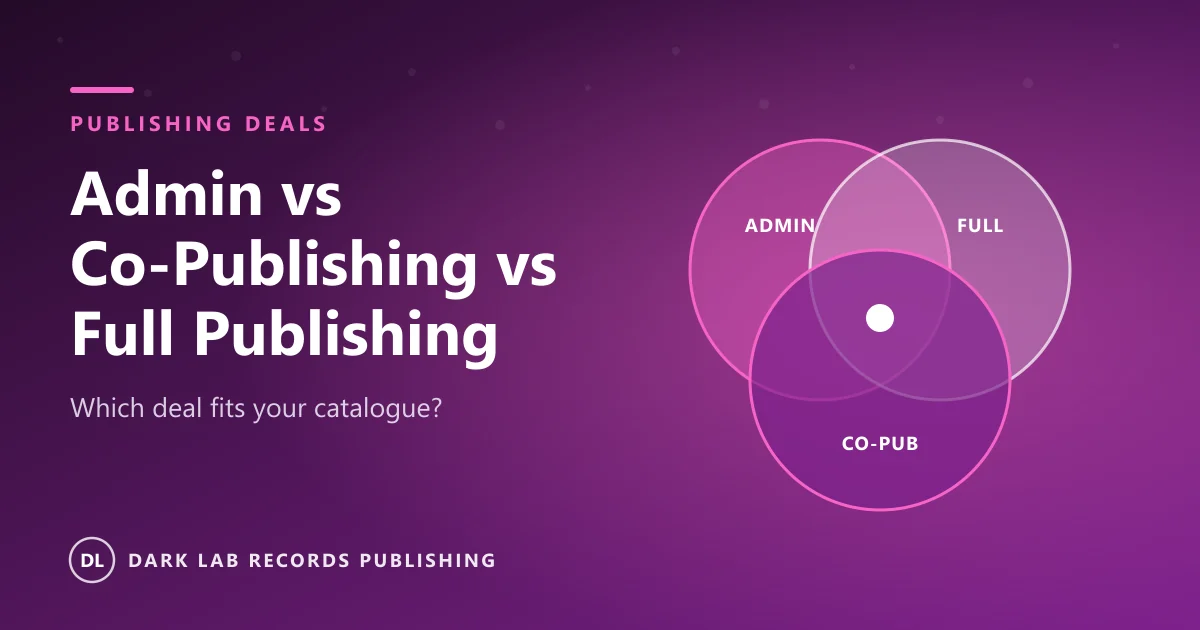
"Publishing deal" is one of the most confusing phrases in the music business, because it hides three very different contracts under one name. Sign the wrong one and you may give away a share of your songs for years; sign the right one and you can collect more money, in more countries, with less admin. This guide compares administration, co-publishing and full (traditional) publishing deals, with real-world percentages, example maths and the questions to ask before you sign.
The key points
- A publishing deal covers songs, not recordings. It is not the same as a record deal.
- In an administration (admin) deal you keep your copyright and pay a fee, commonly around 10–25% of what is collected.
- In a co-publishing deal the publisher owns a share, often 25% of the total, in return for more support.
- In a full publishing deal you assign the copyright for the term, usually for an advance and active career support.
- Percentages vary and everything is negotiable. Always read the term, territory and retention clauses.
A quick refresher: the two halves of publishing income
Publishing income is traditionally split in two: the writer's share (50%) and the publisher's share (50%). When you are unsigned and your own publisher, both halves are yours, provided you have registered them properly. Every deal below is, at heart, a different way of dividing the publisher's half, and sometimes the copyright itself. For the basics, see what a music publisher does.
1. Administration publishing deal
How it works: You keep 100% of your copyright. The administrator registers your songs, collects your royalties worldwide and pays you, keeping a fee.
Typical terms:
- Fee: commonly 10–25% of income collected, sometimes plus a one-off setup charge.
- Term: often one to five years, with renewal options.
- Ownership: stays with you.
- Advance: rare or small.
Example: a song earns £1,000 of publishing income. With a 15% admin fee, the administrator keeps £150 and you receive £850. You still own every part of the song.
Best for: independent writers, artist-writers, producers, small labels and anyone who wants to keep ownership and control but does not have time to chase societies in dozens of countries.
2. Co-publishing deal
How it works: You and the publisher co-own the copyright. You keep your writer's share in full and the two of you split the publisher's share, commonly 50/50. In total, that often works out as a 75/25 split: 75% to you and 25% to the publisher.
Typical terms:
- Income: you receive the whole writer's share plus half of the publisher's share.
- Ownership: shared, usually for the term of the deal.
- Advance: more common than with admin, and linked to expected earnings.
- Support: some creative and licensing help in addition to administration.
Example: on the same £1,000, you receive the £500 writer's share plus £250 (half of the publisher's £500), so £750, and the publisher takes £250.
Best for: writers who want an advance and some hands-on help, and are happy to share ownership in exchange. Be aware that some co-publishing deals are tied to the length of a record deal, so check how long it really lasts.
3. Full (traditional) publishing deal
How it works: You assign your copyright to the publisher for the term of the contract. In return you receive an advance, the publisher's active promotion, and its network. You usually keep the writer's share of income, while the publisher keeps the publisher's share.
Example: on £1,000 of income, you would normally receive the £500 writer's share, and the publisher would keep £500.
Typical terms:
- Ownership: transferred to the publisher for the term, and often for the life of copyright for songs written during it.
- Advance: the main attraction, and it is recoupable from your future earnings.
- Commitments: you may need to deliver a minimum number of songs.
- Support: pitching, creative introductions, sync opportunities.
Best for: writers who want a career partner, accept giving up some control, and have the leverage to negotiate good terms.
Comparison table
| Admin | Co-publishing | Full publishing | |
|---|---|---|---|
| Who owns the copyright? | You | Shared | Publisher, for the term |
| Your income (example) | About 75–90% | About 75% | About 50% |
| Advance | Rare | Possible | Usual |
| Career support | Light | Medium | High |
| Control over your songs | High | Medium | Lower |
| Best for | Independents keeping control | Writers wanting an advance plus ownership | Writers wanting full backing |
These figures are common ranges, not guarantees. Treat them as a way to compare offers, not as a price list.
Clauses that matter more than the headline percentage
- Term and retention. How long does the deal last, and for how long after the end can the publisher still collect on licences it signed?
- Territory. Worldwide, or only some countries?
- Catalogue. Only new songs, or songs you already wrote and released?
- Recoupment. What can be deducted from your income before you are paid?
- Termination rights. What happens if the publisher does nothing with your songs?
- Audit rights. Can you check the statements?
Ask a music lawyer to review any contract that assigns ownership or ties you for several years.
How to choose
- List your goals: maximum income, an advance, creative help, or simply getting registered and paid.
- Count your catalogue and how many countries you are earning in.
- Decide how much ownership you are willing to share.
- Compare offers using the same example amount, for instance £1,000, to see what you would really keep.
- Check what you would need to do yourself: unregistered songs earn nothing under any model. See how to register a song.
Publishing deal key takeaways
- Every publishing deal covers songs, never recordings, so a publishing deal is not a record deal.
- The cheapest publishing deal on paper is not always the best one. Compare what you keep, how long the publishing deal lasts and what is deducted.
- An admin publishing deal keeps ownership with you; co-publishing and full publishing deals share or transfer it.
- Before you sign any publishing deal, ask a music lawyer to review the term, the territory and the termination rights.
- A publishing deal can be renegotiated or ended at the right moment, so write down your goals first.
- If you are unsure which publishing deal fits, start with the simplest one and upgrade when your catalogue earns more.
- Remember: a good publishing deal leaves you better off after fees than you would be alone.
Where Dark Lab fits
Dark Lab Records Publishing works as an administration partner: we register your songs, collect worldwide and report clearly, while you stay in control of your copyright. See what we offer, how it works, or ask us about your catalogue.
Frequently asked questions
What is a publishing administration deal?
You keep 100% of your copyright and an administrator registers your songs and collects your royalties for a fee, commonly around 10–25% of income collected.
What is a co-publishing deal split?
A common structure gives the writer the whole writer's share plus half of the publisher's share, which works out as 75% of income to the writer and 25% to the publisher.
Do I lose my copyright in a publishing deal?
Not in an admin deal. In a co-publishing deal ownership is shared, and in a full publishing deal the copyright is assigned to the publisher for the term. Read the term and reversion clauses carefully.
Is a publishing deal the same as a record deal?
No. A publishing deal covers your songs (compositions). A record deal covers your recordings. You can have one without the other.
Written by
Dark Lab Records Publishing
Practical guidance on music publishing, royalties and rights from the Dark Lab Records Publishing team.