How to Register a Song: PRO, IPI Number, Split Sheet and ISWC Step by Step
A practical seven-step guide to registering your songs so royalties reach you: agree the splits, join a PRO, get your IPI number, register the work, cover mechanicals and keep your data consistent.
On this page
- The key points
- Step 1: Agree the splits before anything else
- Step 2: Join a performing rights organisation (PRO)
- Step 3: Get your IPI number
- Step 4: Register the song (the "work") with your PRO
- Step 5: Cover the mechanical side
- Step 6: Match your identifiers
- Step 7: Keep your data consistent
- A registration checklist
- Common mistakes to avoid
- Register your songs: final tips
- Want it done for you?
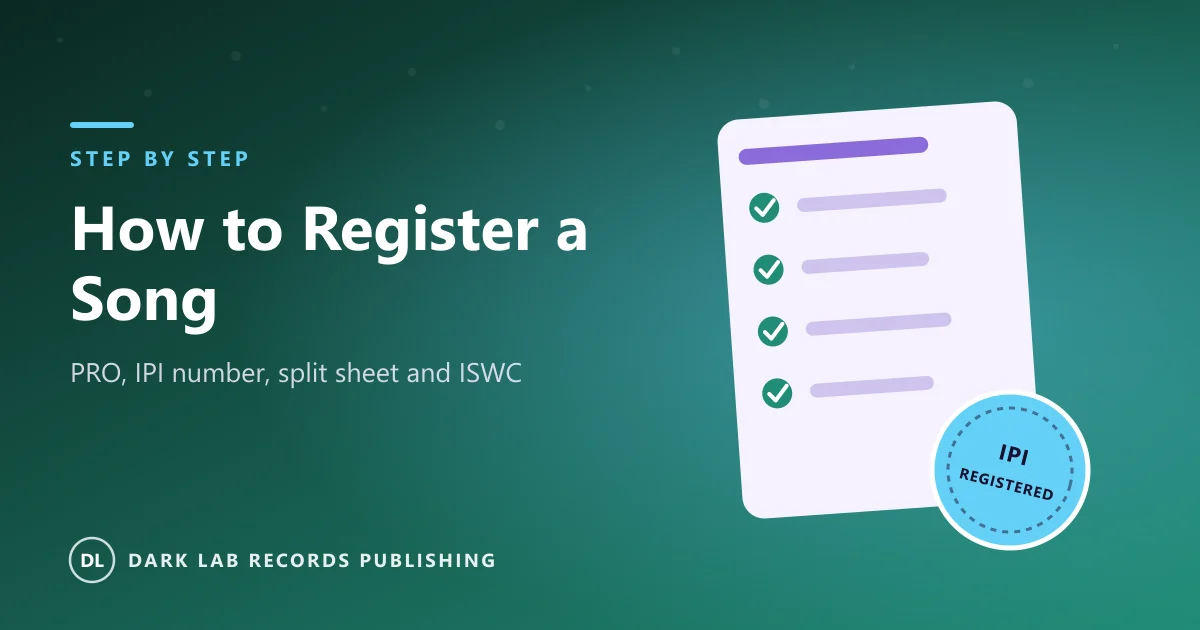
Writing the song is the creative part. Getting paid for it depends on a less glamorous step: registration. If a song is not registered correctly, with the right writers, the right percentages and the right identifiers, royalties are delayed, split wrongly or never paid at all. This step-by-step guide shows you how to register a song, what an IPI number is, how to write a split sheet, and what the codes (ISWC, ISRC) mean.
The key points
- Registering a song means telling the collecting societies who wrote it and who owns what.
- You need an IPI number (it is issued when you join a society) to be identified as a writer or publisher.
- A signed split sheet, agreed before release, prevents most disputes.
- Register with a PRO for performance income and make sure mechanical income is covered too.
- The same details must match everywhere: your distributor, your society and your administrator.
Step 1: Agree the splits before anything else
As soon as a song is finished, write down who contributed what. A split sheet is a short document, signed by every writer, that states each person's percentage of the composition. Include:
- The song title (and any working title or alternative spelling)
- Each writer's full legal name, not just a stage name
- Each writer's IPI number, society and role (music, lyrics or both)
- Each writer's publisher, if they have one
- The percentage each person owns, adding up to exactly 100%
- Date and signatures
Do this when everyone is still friends. Disagreements over ownership are one of the most common reasons royalties get held up, and a signed split sheet is the first thing a society will ask for if there is a dispute.
Step 2: Join a performing rights organisation (PRO)
A PRO collects performance royalties for you: when your song is played on radio, on TV, in public or streamed. Choose the society for the country where you live, or where most of your income comes from:
- UK: PRS for Music
- United States: ASCAP, BMI, SESAC or GMR (you can only be a writer member of one US PRO at a time)
- Canada: SOCAN
- Elsewhere: the national society in your country
Joining usually involves an application, ID checks and sometimes a one-off fee. If you also own your publishing, register a publishing entity so the publisher's half of the income has somewhere to go. Skipping this is one of the most frequent and costly mistakes.
Step 3: Get your IPI number
An IPI (Interested Parties Information) number is a unique identifier for a writer or publisher in the collecting-society system. You normally receive it automatically when you join a society. It can take from a few days to a few weeks. Write it down, because you will need it on every split sheet and registration form.
Step 4: Register the song (the "work") with your PRO
Joining a society links you to the system. Registering the work links your song to you. In your PRO's online portal you will typically enter:
- The title of the composition
- All writers, their IPI numbers and their percentage shares
- The publisher(s) and their shares
- Any alternative titles, the duration and the recording details if asked
Some societies count writer and publisher shares separately, so totals can reach 200% on screen. That is normal. Always follow the rules on the society's own form.
Step 5: Cover the mechanical side
A PRO usually does not collect your streaming mechanical royalties. Depending on where you are:
- In the UK, mechanical royalties are collected through MCPS.
- In the US, self-published writers register with The MLC to collect US digital mechanical royalties.
- An administrator can register your songs with all of these at once.
To see how the three income types fit together, read performance, mechanical and sync royalties explained.
Step 6: Match your identifiers
| Code | Identifies | Who assigns it |
|---|---|---|
| ISWC | The composition (the song itself) | The registering society, after the work is registered |
| ISRC | One specific recording | Your distributor or label |
| IPI | A writer or publisher | The society you join |
| UPC / EAN | A release (single, EP or album) | Your distributor |
Collecting societies and streaming services use these codes to match plays to songs. If a recording's ISRC is not linked to the right ISWC and writers, the money cannot be matched. It then ends up in the unmatched pot we describe in our guide to black box royalties.
Step 7: Keep your data consistent
Use exactly the same song title, writer names and splits in your distributor, your PRO, your mechanical registration and your administrator. Small differences (a missing "feat.", a nickname instead of a legal name, a different percentage) are enough to stop automated matching. Check your first statements to confirm that streams of the song appear under the right writers.
A registration checklist
- Split sheet signed by every writer
- PRO membership active, IPI number noted
- Publishing entity registered if you own your publishing
- Work registered with every writer and share
- Mechanical collection arranged (MCPS, The MLC or an administrator)
- ISRC and ISWC recorded and consistent
- Co-writers' publishers notified
- Statements checked within the first few months
Common mistakes to avoid
- Registering with a stage name instead of the legal name
- Splits that add up to more or less than 100%
- Never registering as a publisher, so half of the income is never claimed
- Assuming the distributor registers the composition (it only handles the recording)
- Changing splits later without telling every society
Register your songs: final tips
The sooner you register a song, the sooner it can earn. Register before release if you can, and register older songs now rather than later. When you register a work, double-check every name and percentage, because it is much easier to register correctly once than to fix a registration after money has been held.
If you collaborate often, ask each co-writer to register their own share using the same title and splits. If you would rather not register every work yourself, an administrator can register your songs with each society for you. Either way, keep a copy of every registration so you can compare it with your statements.
Finally, register your publishing entity as well as yourself as a writer, and register each new song as soon as the split sheet is signed.
Want it done for you?
Registration is exactly the kind of detailed, repetitive work an administrator does every day. Dark Lab Records Publishing registers your compositions, keeps your data consistent and collects the income. See how it works, learn about our songwriter services, or contact us to get your catalogue registered correctly.
Frequently asked questions
How do I register a song to get paid royalties?
Agree the splits in writing, join a performing rights organisation to get an IPI number, register the work with every writer and share, and make sure mechanical royalties are also covered by MCPS, The MLC or an administrator.
What is an IPI number?
An IPI (Interested Parties Information) number is a unique identifier for a songwriter or publisher in the collecting-society system. You normally receive one when you join a society.
What is a split sheet and do I need one?
A split sheet is a signed document recording each writer's percentage of a song. It is not a legal requirement, but it prevents disputes and is the first thing a society asks for if ownership is questioned.
What is the difference between ISRC and ISWC?
An ISRC identifies a specific recording and is assigned by your distributor or label. An ISWC identifies the underlying composition and is assigned after the work is registered with a society.
Written by
Dark Lab Records Publishing
Practical guidance on music publishing, royalties and rights from the Dark Lab Records Publishing team.