Black Box Royalties and The MLC: How to Find and Claim Unpaid Music Royalties
Why music royalties end up unmatched, how The MLC handles US digital mechanical royalties, and a five-step plan to find, fix and claim the money that is waiting for you.
On this page
- The key points
- What exactly is the black box?
- Why royalties end up unmatched
- Where does The MLC come in?
- How to find and claim your missing royalties
- Step 1: List your songs and recordings
- Step 2: Check you are registered where you need to be
- Step 3: Search the unmatched lists
- Step 4: Fix and claim
- Step 5: Prevent it from happening again
- Unclaimed does not mean forever
- Black box and your income type
- Black box FAQ
- How we can help
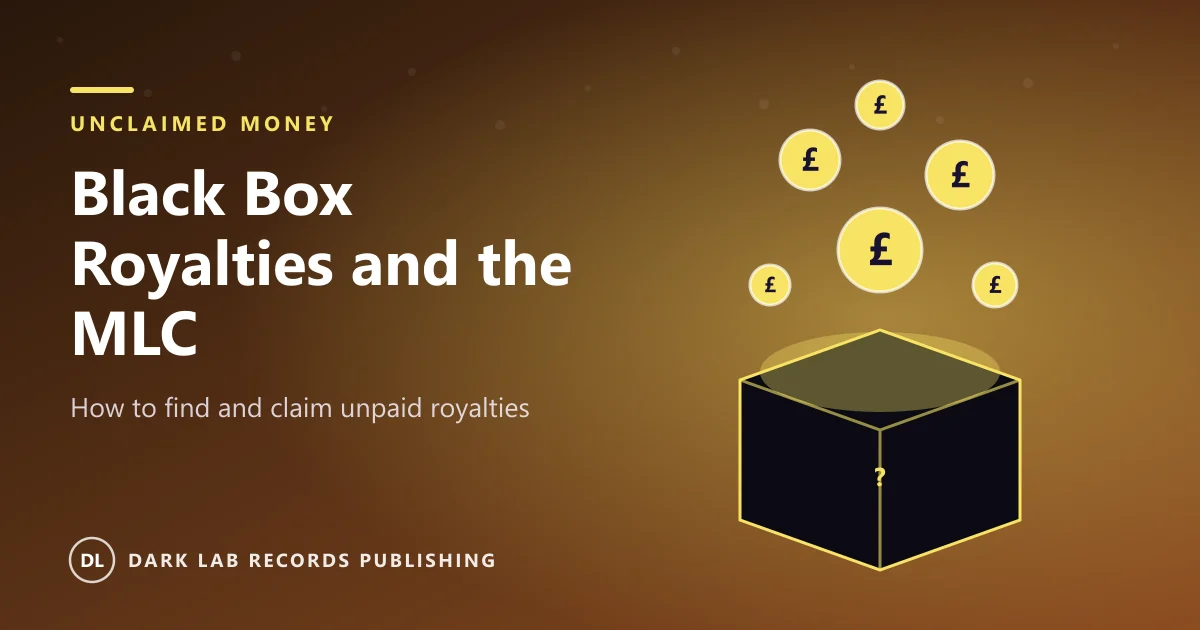
Every year, a large amount of music royalties is collected but never paid to the people who wrote the songs. The money does not vanish: it sits in holding pools at collecting societies, usually called the "black box", waiting for a rightful owner to claim it. This guide explains what black box royalties are, why they happen, how The MLC fits in, and what you can do to find and claim your share.
The key points
- Black box royalties are royalties that were collected but could not be matched to a songwriter or publisher, so they were not paid.
- The usual cause is missing or inconsistent data: wrong writer names, no registration, mismatched splits or missing identifiers.
- In the United States, The MLC collects digital mechanical royalties and holds unmatched money. It does not collect performance royalties.
- Money can usually be claimed only if you register and fix your data, and unclaimed amounts may eventually be shared out among other members after a holding period.
- The fix is mostly prevention: register correctly, everywhere, and check your statements.
What exactly is the black box?
When a song is streamed, downloaded or played, a service reports the usage and pays royalties to a collecting organisation. That organisation then has to work out whose song it was. It does this by matching the usage data (title, recording code, artist, writers) against the registrations it holds. If the match fails, the money cannot be sent to anyone. It goes into a pool of unmatched or unclaimed funds. That pool is the black box.
Black boxes exist wherever royalties are collected: in the United States, in the UK and Europe, and in every other territory. They are not a scam. They are a data problem, and writers who do not register or whose data is wrong are the ones who lose out.
Why royalties end up unmatched
- The song was never registered with the society or mechanical body at all.
- Different titles or spellings across the distributor, the PRO and the administrator.
- Missing identifiers: no ISRC-to-ISWC link, no IPI number for a co-writer.
- Disputed or conflicting splits where two registrations claim more than 100%.
- Stage names used instead of legal names.
- The publisher's half never claimed because the writer never registered a publishing entity.
- Sampling, covers and remixes where the original writers were not credited.
Most of these come down to the registration steps we describe in our guide on how to register a song.
Where does The MLC come in?
In the United States, digital services such as streaming platforms must pay mechanical royalties for the songs they stream. Since 2021, a non-profit body called The Mechanical Licensing Collective (The MLC) has administered the blanket licence that covers this. It collects those digital mechanical royalties and pays them to its members.
Three points are worth remembering:
- You may need to register. If you are a self-published writer who has not assigned your publishing to a publisher or administrator, you generally need to join The MLC yourself to collect US digital mechanical royalties. If you have an administrator, they usually register for you.
- It covers digital mechanicals only. The MLC does not collect performance royalties. Those go through your PRO (PRS, ASCAP, BMI and so on).
- Unmatched money is held and searchable. The MLC publishes tools that let members search for unmatched works, and unclaimed amounts may be distributed to members after a holding period set out in the law.
The details, deadlines and rules can change, so check The MLC's own website for the latest position before you act.
How to find and claim your missing royalties
Step 1: List your songs and recordings
Make a spreadsheet of every song with its writers, shares, titles, release dates, ISRCs and, once you have them, ISWCs. Your distributor's dashboard is a good source for recordings.
Step 2: Check you are registered where you need to be
- PRO membership (performance income)
- Publisher registration if you own your publishing
- Mechanical collection: MCPS in the UK, The MLC for US digital, or an administrator
Step 3: Search the unmatched lists
Use the search tools offered by The MLC and your society to look for your song titles, your name and your co-writers' names. Third-party "checker" tools exist too, but they are not official, so treat their results as hints, not proof.
Step 4: Fix and claim
If you find a match, correct the registration, add the missing writer or share, and submit a claim with supporting documents such as the split sheet. Be patient: matching and payment cycles take weeks or months.
Step 5: Prevent it from happening again
- Register every new song before release.
- Use legal names and identical metadata everywhere.
- Keep a signed split sheet for every song.
- Review your statements each quarter and look for songs with streams but no publishing income.
Unclaimed does not mean forever
Many societies set time limits: after a certain period, unclaimed funds may be distributed to other members, often in proportion to their market share. That means the longer your songs stay unregistered, the greater the chance that money is paid to someone else. If you released music a few years ago and never set up publishing collection, it is worth checking now.
Black box and your income type
Each of the three royalty streams can end up unmatched, but for different reasons. A summary:
| Income | Usually unmatched because | Where to check |
|---|---|---|
| Performance | Song not registered with a PRO, or wrong splits | Your PRO's portal |
| Mechanical | No mechanical registration, missing identifiers | The MLC, MCPS or your administrator |
| Sync-related performances | Cue sheets missing or incomplete | Your PRO and the production company |
If you want the background on each stream, see performance, mechanical and sync royalties explained.
Black box FAQ
What is the black box in music? The black box is the pool of collected royalties that could not be matched to a songwriter or publisher.
Is the black box illegal or a scam? No. The black box is a data problem, not a crime. Money lands in the black box when registrations are missing or inconsistent.
Can I get money out of the black box? Yes, if you register your works, fix your data and claim before the holding period ends. Each organisation has its own black box rules.
How do I know if I have black box royalties waiting? Search the unmatched lists of The MLC and your societies for your song titles, and compare your streams with your publishing statements.
Does every country have a black box? Yes. Every society that collects royalties holds unmatched money, so the black box exists in every territory where your songs are played.
How do I keep my royalties out of the black box? Register every song early, keep your metadata identical, sign your split sheets and review statements regularly. A publishing administrator can monitor the black box for you.
How we can help
Dark Lab Records Publishing audits your catalogue, fixes registration problems, registers your songs with the right bodies and collects the income, including money that was previously sitting unclaimed. Read about our royalty collection, see how it works, or contact us to ask us to check your catalogue for missing royalties.
Frequently asked questions
What are black box royalties?
Royalties that were collected but could not be matched to a songwriter or publisher, usually because of missing or inconsistent data. They are held in a pool until someone claims them.
Does The MLC pay performance royalties?
No. The MLC collects US digital mechanical royalties. Performance royalties are collected by PROs such as PRS, ASCAP and BMI.
How do I claim unclaimed royalties?
Register with the right bodies, search the unmatched lists, correct your registration data and submit a claim with supporting documents such as a split sheet. Matching and payment can take weeks or months.
Can unclaimed royalties expire?
Often yes. Many societies distribute unclaimed funds to other members after a holding period, so the longer a song stays unregistered, the greater the risk the money is paid to someone else.
Written by
Dark Lab Records Publishing
Practical guidance on music publishing, royalties and rights from the Dark Lab Records Publishing team.